
Guest post by Banafsheh Zand at Iran So Far Away
Khamenei’s funeral was choreographed to signal revenge – not reconciliation

 The Second Leader’s Dossier Is Closed: What Is Khamenei’s 37-Year Legacy?
Khamenei funeral lays bare deep political divisions in Iran
Khamenei funeral struggles to stay on script
A Funeral for a Regime, not a Nation: Khamenei’s Delayed Burial Exposes the Islamic Republic’s Crisis
Written by Banafsheh Zand and Sophie Baron AmirTeymour
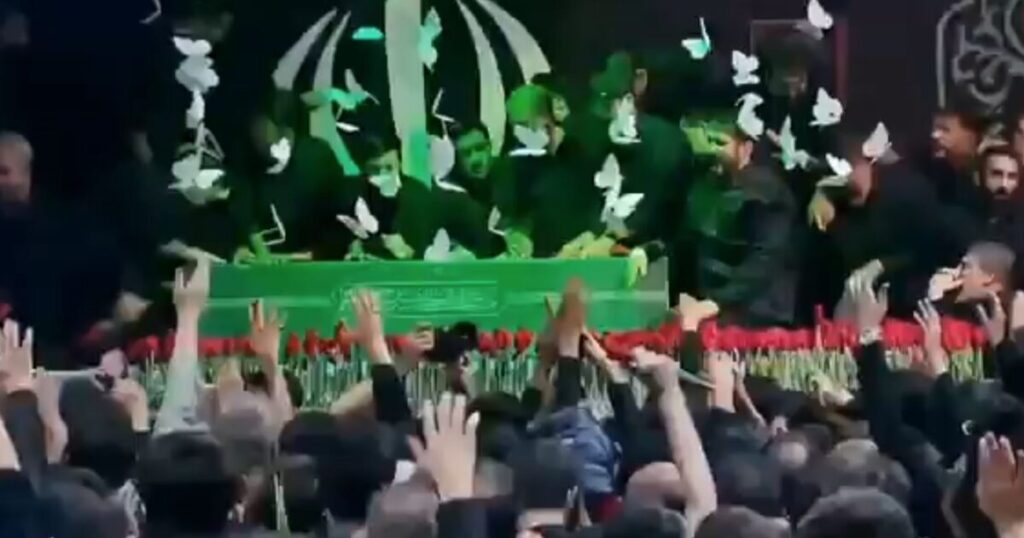
The Islamic Regime has tried to turn Ali Khamenei’s funeral into a spectacle of continuity, revenge, and survival. Instead, the week-long ceremony has exposed the regime’s deepest vulnerabilities: a dead ruler, an invisible successor, a grieving dynasty, a militarized public ritual, and a population increasingly unwilling to confuse state choreography with national mourning.
Ali Khamenei was killed on February 28th during an Israeli airstrike on his underground bunker. Under Shi’a Islamic rules, his burial should have occurred within 24 hours of his death. However, the ruling clerics chose to ignore custom so that another public scene could be arranged to make the international media display crowds of Iranians seemingly in monolith behind their system. The Regime does not bury its leaders quietly. It uses them, even in death, to demand obedience from the living.
Khamenei’s funeral was postponed several times and only held after the provisional deal with the USA was signed on June 14, ending the war for the moment. A week of events from July 4-9 was scheduled, beginning in Tehran, then proceeding to Qom and then the holy cities of Najaf and Karbala in Iraq – where Khamenei spent so much of Iran’s blood and treasure building up Shi’a forces to serve as his personal dominators of that country – and culminating in Khamenei’s entombment in the holy city of Mashhad next to the Imam Reza, effectively deifying him. To ensure as large a crowd as they could gather, officials offered a destitute populace 50 million loaves of bread, 1000 free cabs were deployed in Tehran, grocery stores were kept open 24 hours a day, and hotel rates were halved. Workplaces, shops, and all public gathering spaces were closed, and threatened with heavy penalties if they remained open and their employees in turn pressured to attend the ceremonies. Under the watchful eye of the security forces, it was hoped these measures would suffice to gather the hoped-for million people into the streets. To help with that, mourners were flown in from Iraq.
That’s it?
This was all they could muster for Ali Khamenei’s funeral despite free food, forced participation, vast state resources, and nonstop promotion across state media?
The Iranian diaspora has drawn larger rallies in Toronto, London and Los Angeles through nothing more…
— The Iran Watcher
(@TheIranWatcher) July 4, 2026
In choosing July 4, it was obvious that the regime was trying to compete with Donald Trump’s 250th anniversary of America festival. The United Arab Emirates, which had been the victim of multiple missile strikes from the Regime, took the opportunity to diplomatically snub Tehran and send fighter jets to fly over New York. Tehran’s gala guests would be limited to the leaders of border countries and lower-profile officials from Russia and China.
The buildup had been intense, but when it finally happened, the first comments on social media- before the official media could begin their spin – were about underwhelming the turnout was.
I just spoke with multiple sources on the ground in Tehran.
According to them, the turnout for Khamenei’s funeral was surprisingly thin, only a few thousand people at most. That number included Afghan mercenaries, Iraqi Hashd al-Shabi fighters, and regime-invited supporters flown… https://t.co/Hmkez6XJam— Sana Ebrahimi Ledene (@__Injaneb96) July 6, 2026
Commentators also pointed out how the pre-arranged route had been changed. By following the planned march course, a large, continuous procession would have proceeded across a major part of Tehran. However, televised coverage repeatedly focused on selected locations. The lack of continuous coverage from the announced starting point to the final destination was seen as the first major sign that the expected crowd did not materialize. Images from Ferdowsi Square were particularly damaging – when state television briefly showed that area, the crowd appeared thin and unimpressive compared with the scale being claimed.
In a city of 10 million and a country of 90 million, the regime was unable to bring together more than 100,000 people for the most consequential event in its entire history. pic.twitter.com/NdMwWIDXOC
— Rastakhiz
(@sedaye_iran) July 4, 2026
Violence against the infidels is sure to be a feature of any regime event. On the third day of the funeral procession, July 6, the media showed regime supporters carrying banners threatening to kill President Donald Trump, an image of Trump was hanged in effigy while passers-by hurled stones at it, and a poet exclaimed “I swear by your blood; Trump’s murder is our responsibility.” This is classic Islamic Republic theater: grief weaponized into murder rhetoric, mourning converted into mobilization, and death turned into a loyalty test.
Meanwhile, Iranians were questioning officials inflated turnout numbers – which rose from two to ten and then twelve million, before ultimately being called the largest human gathering in history. Several rough calculations were used to challenge the official narrative. Even if one assumed a long route packed with people, the physical space would not support claims of tens of millions. A route several kilometers long and several dozen meters wide can hold only a limited number of people, especially when accounting for buses, police vehicles, barriers, trees, gutters, temporary stands, empty gaps, and movement corridors. State-controlled media assertions of five or six people per square meter are unrealistic, especially across an entire route. In a dense, crowded space, such numbers may exist briefly when bodies are crushed against each other, but they cannot be applied casually to kilometers of public streets. Viewers also noticed differences between ground and aerial images, and wondered if photos were being doctored.
Don’t let them fool you with AI generated images. The number of people who attended Khamenei’s funeral was barely 120,000 and that’s in a city of 11M (Tehran).
These are the real photos of the event
@realDonaldTrump #موشعلی pic.twitter.com/A0O9aX10Y1
— Arash Barzan (@ArashBarzan_) July 5, 2026
More importantly, Iranians were asking how much all of this was costing them and they criticized both the enormous expense and the lack of transparency regarding it. This is ironic, for the Islamic Regime came to power in 1979 trumpeting false accusations against the former Imperial government’s “extravagant” holding of the 1971 Persepolis anniversary celebrations.
This was never just a funeral. It was a state operation designed to convert a military and political humiliation into a ritual of “martyrdom.” The regime’s message is obvious: Khamenei may be dead, but the Islamic Republic claims to live on. Yet the symbolism cuts both ways. A regime that spent decades projecting invulnerability has been forced to parade the coffin of its longest-serving Supreme Leader through a heavily managed mourning circuit months after he was killed at the center of his own power structure. Iran International described the funeral as an attempt to recast a humiliating wartime death as “martyrdom, continuity and power,” but that effort itself shows how wounded the system has become.
Reuters’ funeral footage kept conveniently skipping the wide shots that would’ve exposed how empty it actually was. They were clearly editing and cherry-picking angles to make the crowd look bigger than it was.
I watched nearly 9 hours of their “live” coverage on fast-forward, it… https://t.co/6Seu70opxx pic.twitter.com/osZOD4WbIq— Sana Ebrahimi Ledene (@__Injaneb96) July 7, 2026
Reuters’ funeral footage kept conveniently skipping the wide shots that would’ve exposed how empty it actually was. They were clearly editing and cherry-picking angles to make the crowd look bigger than it was.
I watched nearly 9 hours of their “live” coverage on fast-forward, it… https://t.co/6Seu70opxx pic.twitter.com/osZOD4WbIq— Sana Ebrahimi Ledene (@__Injaneb96) July 7, 2026
The wound can be best typified by the absence of Ali Khamenei’s son and successor – Mojtaba. Mojtaba Khamenei, the man who has neither been seen nor heard since February but whose picture is all-pervasive, is the epitome of what the Islamic Regime is at the moment. A state without citizens has a ruler without a visible body. Mojtaba’s authority is proclaimed by posters, books, statements, and loyalty oaths, but not through his own physical presence. In a regime obsessed with presence, ceremony, and visual shows of submission, the missing successor speaks louder than the funeral chants. For a system built on the image of divine authority, this is a serious problem. The revolution that said it would bring back the Hidden Imam – the long-awaited leader of the Shi’a whom they believe to be alive but “in occultation” now itself is led by a non-human presence. Rumours that Mojtaba is, in fact, dead continue to be repeated and amplified.
Intra-regime infighting also did not take a pause for the funeral. Former President Hassan Rouhani and Vice-President Mohammad Javad Zarif, leaders of the Reformist faction, either did not attend or did so unostentatiously, rather than risk receiving jeers from hardline supporters. During the ceremony, chants such as “death to compromise” were heard being directed at President Masoud Pezeshkian. This was not the called-for unity.
Even Khamenei’s wife became part of the Regime’s fog. Initial state-media reports claimed that Mansoureh Khojasteh Bagherzadeh had died from injuries sustained in the same strike that killed her husband, but Fars News, affiliated with the IRGC, later said she was alive and that earlier reports were incorrect. The confusion is telling. In a system that controls information as tightly as the Islamic Republic does, even the status of the dead leader’s wife became unstable public knowledge.
And yet despite all of the above, in its coverage of the past few days, the international media that typically repeats the Regime’s assertions without scepticism largely bought the narrative Tehran wanted to convey, a devoted nation mourning their spiritual and temporal master. But even their correspondents in Tehran were forced to admit the public response appears far more complicated than the official narrative suggests. Not too far away from the funeral grounds, Tehran café society continues as usual, with city-dwellers visibly indifferent towards the extravaganza.
The Islamic Republic is not in mourning on behalf of the nation. At a time when Iranians’ living standards have never been lower, it is spending the nation’s treasury to mourn itself.
The regime wants the world to see a sea of mourners. But what is also visible is fear: fear of empty streets, fear of Mojtaba’s absence, fear of public indifference, fear of internal fracture, and fear that Khamenei’s death may not strengthen the system but expose the rot beneath it.
Ali Khamenei’s funeral is being staged as a farewell to a “martyr.” In reality, it is a referendum on the Islamic Republic’s remaining claim to legitimacy. The coffin is not only carrying Khamenei. It is carrying the regime’s fantasy that coercion, propaganda, and choreographed grief can still substitute for genuine national loyalty.
And that fantasy is looking increasingly hard to sell.
Former Democrat staffer for Elizabeth Warren, Calla Walsh, attends Ayatollah Khamenei’s funeral in Tehran, declaring him to be the greatest leader of her life. pic.twitter.com/ImCh8uILas
— Right Angle News Network (@Rightanglenews) July 4, 2026
See more coverage from the Ayatollah’s funeral at Iran So Far Away.
The post A Funeral for a Regime, not a Nation: Khamenei’s Delayed Burial Exposes the Islamic Republic’s Crisis appeared first on The Gateway Pundit.