
This post was originally published on this site.
In a recent article in The Washington Post, reporters laid off from Voice of America lamented the demise of an industry. One ex-journalist who lost his job last year now works at a Trader Joe’s, another at a coffee shop.
The story was about the tumultuous state of the news business under President Donald Trump. Early in his second term, Trump signed an executive order scaling back operations at the federally funded international broadcaster, leading to extensive cuts in both jobs and news coverage.
Four paragraphs deep, the article was interrupted by another disruptive force that journalists warn is coming for their jobs: a chatbot.
“Dive Deeper,” the prompt on The Post’s website reads, directing readers to “ask a follow-up question,” with responses from a chatbot trained on news articles written by humans.
As consumers increasingly turn off the news and pivot instead to artificial intelligence tools like ChatGPT and Claude for information about current events, legacy outlets have increasingly found themselves at war — and in courtrooms — with technology behemoths.
One of the tools that news publishers are using to fight the rise of chatbots that scrape their content and regurgitate it as their own? They’re building chatbots based solely on their own journalism.
Among them is “Ask The Post,” a chatbot created by Arc XP, The Washington Post’s tech arm. Launched inside a subset of the outlet’s content a year ago, The Post is now rolling out the product across all of its articles. And in the coming weeks, the chatbot is set to go live at other news outlets that contract with Arc XP for their content management systems, said Joey Marburger, the vice president of content intelligence at Arc XP.
“Sixteen months ago people would have balked at it and been like ‘Oh, we don’t trust this, we don’t want it to hallucinate and give inaccurate answers,” Marburger told Straight Arrow. “Well, that’s literally the whole product — to not do that.”
‘Ask The News’
For legacy news outlets like The Post, technology companies’ embrace of AI is clear, with real implications for readership. Currently, only a fraction of people get their news from chatbots, but year-over-year growth in AI adoption suggests the future information landscape could look very different.
About 10% of people use chatbots weekly for news, according to a global survey published in June by the Reuters Institute for the Study of Journalism. The results represent a 3 percentage-point increase from last year.
While ChatGPT and other chatbots link to the underlying sources behind their responses, only 4% of people who use the tools actually click on them, according to the survey.
That growth is one reason The Post’s Arc XP is branching out, Marburger said. Earlier this month, the company announced Ask The News, making the chatbot that’s been live at The Post for more than a year available to other publishers.
The announcement came with a dire warning about an industry in distress — and a solution to stop the bleeding.
“Every day, millions of readers who once visited a news site now get their answers from ChatGPT, Perplexity, or Google’s AI Overviews — without the publisher seeing a single pageview, collecting a data point, or earning a cent,” the company announced in a media release. The company said Ask The News was “designed to stop that.”
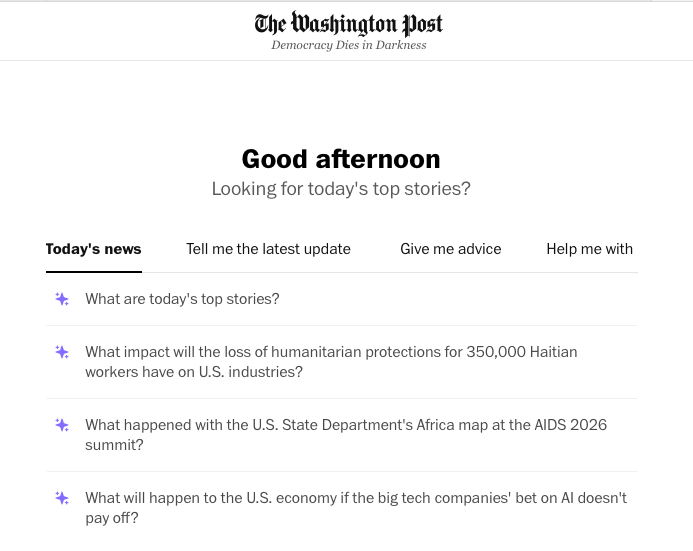
Marburger declined to comment on which news outlets were preparing to roll out the “Ask the News” chatbot in the coming weeks. More than 70 publishers globally are Arc XP customers for its content management system, including The Boston Globe, The Dallas Morning News and The Irish Times.
A year ago, many news outlets were hesitant to build chatbots into their operations, Marburger said. Had Arc XP launched “Ask the News” before piloting the product on The Post, he said, “we would have had a really hard go with it.”
“People were much more hesitant and they were worried about cannibalization, having their content scraped and things like that,” he said.
The landscape since then, he said, has changed.
Still, a majority of Americans remain skeptical of AI-powered news, and among those who do rely on ChatGPT for current events, half said they sometimes come across information they believe is inaccurate, according to recent surveys by the Pew Research Center.
Even as leading publishers, including USA Today, roll out their own chatbots, they’ve also taken a hostile stance on AI, including through lawsuits accusing Big Tech companies of copyright infringement and of rigging the online advertising market. Among them is The New York Times, which has taken aim at OpenAI and Microsoft on allegations the companies use the newspaper’s published work to train its AI tools without permission or compensation.
Reporters at some outlets have also openly revolted against news publishers’ pivot to AI. Among them are journalists at McClatchy Media, where reporters at the company’s local newspapers — including the Miami Herald and The Kansas City Star — have protested the rollout of an AI tool that rewrites their stories and utilizes their bylines.
The most recent litigation comes from News Corp, the parent company of The Wall Street Journal and the New York Post. In July, it sued the privacy-focused search engine Brave AI, alleging the company provided “summaries” of news articles to its users that are “verbatim or near verbatim” copies of its journalism.
How publishers can combat AI-driven misinformation
Differentiating publisher-led chatbots, Marburger said, is a laser focus on accuracy and grounding in original journalism. It’s a major departure from ChatGPT and other frontier models, he said, which rely on disparate sources including “random stuff from Reddit and things that may not be true.”
Frontier models are trained to serve convincing answers regardless of whether enough information exists to provide an accurate response, Marburger said, while The Post’s chatbot relies on strict controls and is quick to say when it is unable to provide an answer based solely on articles published in the news outlet’s archive. In fact, The Post’s tool was built with “a bias of not having an answer” for every question, he said.
“It’ll say ‘I don’t have an answer for that,’” Marburger said. “And that’s OK.”
In a test, Straight Arrow could not get The Post’s chatbot to hallucinate or provide speculation. However, the tool can be veered off course. The chatbot embedded in the article about Voice of America, for example, was quick to provide information — complete with links to seven articles by The Post — about the first person to walk on the moon.
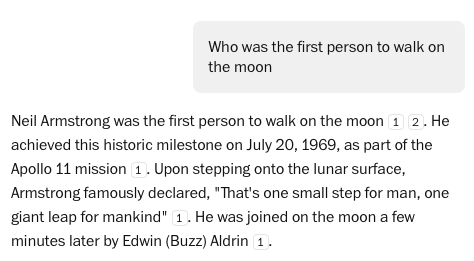
Marburger said the tool is still a work in progress. It includes a warning that “AI can make mistakes,” and prompts users to “verify information by referencing provided sources for each answer.”
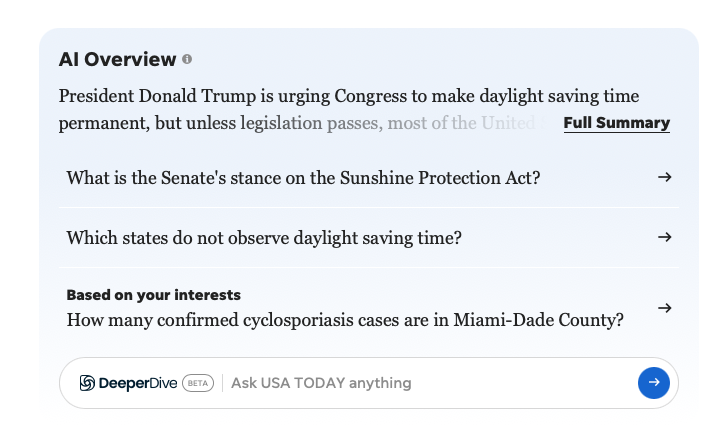
USA Today is also experimenting with a chatbot, called DeeperDive, that is embedded into its homepage and in news articles. Launched in September and built by the advertising firm Taboola, the tool only serves responses that link back to the newspaper’s articles.
The chatbot is built with controls to notify users when it is “unable to provide a complete answer,” and humans conduct routine audits to identify responses that don’t meet “our standard of accuracy as a journalistic enterprise,” said Kara Chiles, USA Today’s senior vice president of product management.
USA Today also operates more than 200 local newspapers, including The Arizona Republic in Phoenix and The Burlington Free Press in Vermont. Later this year, DeeperDive will make its way to the company’s local brands, Chiles told Straight Arrow.
Audience engagement with DeeperDive has changed over time, Chiles said, but most of the tool’s users stick with built-in prompted questions, rather than asking questions of their own. Ultimately, she said, people are using it “to truly, as promised, go deeper.”
“So they are actually spending more engaged time on our site,” Chiles said, and using provided prompts “to further explore the subject that brought them in.”
Can news outlets survive the AI revolution?
As legacy publishers warn of getting crushed by emerging technology, a recent report by web analytics firm Chartbeat highlights a nuanced picture. Across news brands, the company says it tracks billions of pageviews every month. The situation, the company concluded, “isn’t as dire as other reports would have you believe.”
Between 2024 and 2025, average weekly total pageviews dropped about 6%, which could be attributed not just to technology but to the ebb and flow of “global event cycles.”
Chatbots currently account for less than 1% of pageviews, according to Chartbeat, though “there’s no doubt” the tools have “quickly become part of the media ecosystem.”
Jill Nicholson, Chartbeat’s chief marketing officer, said the emergence of AI has affected consumers’ behaviors in ways that could further accelerate.
“It’s conditioning people to expect a zero-click, conversational engagement experience,” Nicholson told Straight Arrow. “It therefore makes sense that publishers are beginning to incorporate AI chatbots into their existing reader experiences, informed by decades of trusted reporting and deep editorial expertise.”
As news consumers become increasingly acclimated to using AI tools, Chiles said, it’s critical for publications to adapt with them.
“We ignore this technology shift at our own caution,” Chiles said. But USA Today is transparent about the fact that Deeper Dive is in beta mode while the company learns as it goes. “It is all part of recognizing that AI is a technology that is not going away.”
But that doesn’t mean chatbots are coming for reporters’ jobs, Marburger said. In many ways, he said, the rise of AI resembles the promises — and challenges — that came with the rise of the internet in the 1990s.
“It’s evolving so fast right now,” he said. “If you’re not trying and living along the wave of AI, it could just completely crash on you one day.”
Round out your reading
- Why Gen Z is staying home on the weekends.
- Autism research is entering a new era. Here’s what scientists are learning.
- The big reason small cities want data centers. Hint: It’s not permanent jobs.
- High school teacher arrested at city meeting after clapping for anti-data center speech.
- Off Script: Everyone’s watching Michigan. Our reporter explains why the race just changed.