This post was originally published on this site.
The Centers for Disease Control and Prevention and Food and Drug Administration announced late last week they were investigating a multi-state Salmonella outbreak as federal health officials continue to track thousands of Cyclospora cases. The simultaneous outbreaks have renewed scrutiny of the nation’s food safety system.
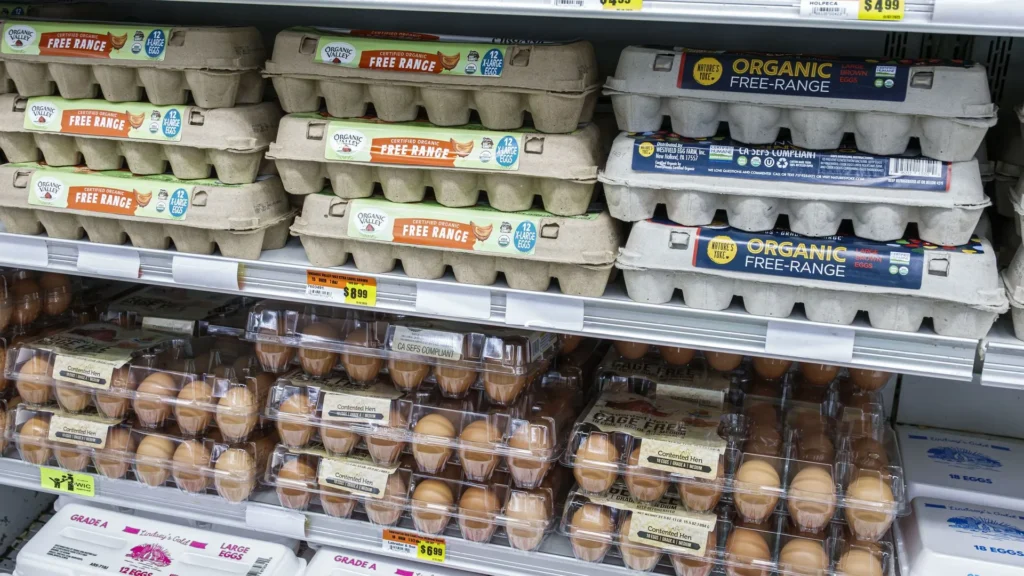
The Salmonella cases have been linked to eggs produced at two Midwest Poultry Services farms in Texas. So far, 98 people have been infected and 26 hospitalized across 17 states. The company recalled more than a million eggs.
The FDA also recently announced a new Cyclospora outbreak that has sickened at least 72 people. Investigators have not yet identified the source of the parasite, though they confirmed it was separate from a larger, ongoing outbreak that has sickened more than 7,500 people in Indiana, Kentucky, Michigan, Ohio and West Virginia. Those infections have been linked to now-recalled iceberg lettuce distributed by Taylor Farms.
Overall, the FDA is investigating 12 active outbreaks, and four others were recently declared over.
Several former FDA officials and food safety experts argue that actions taken by the Trump administration — including funding cuts, changes to disease surveillance and the closure of research facilities — have weakened the nation’s food safety infrastructure and could hamper the detection and investigation of foodborne illness outbreaks.
“Last year, you terminated the U.S. Centers for Disease Control and Prevention’s (CDC’s) Foodborne Diseases Active Surveillance Network (FoodNet) required surveillance of Cyclospora cayetanensis, the parasite responsible for cyclosporiasis. And now a cyclosporiasis outbreak sweeps the nation,” Senator Jon Ossoff wrote in a letter addressed to Health and Human Services Secretary Robert F Kennedy, Jr. “Your foolish and self-indulgent demolition of critical public health programs puts Americans at risk.”
Frank Yiannas, the FDA’s deputy commissioner for food policy and response between 2018 to 2023, called for an independent review of the federal government’s handling of the Cyclospora outbreaks.
“This one deserves a lot of questions, and it is starting to approach a catastrophic level in terms of how mismanaged it’s been on multiple fronts,” he told Politico.
Whether recent Trump administration policy changes have contributed to a rise in foodborne infections remains an open question. Straight Arrow examined the evidence.
Changes to food safety oversight
The Trump administration has made a series of changes to the nation’s food safety system over the past year and a half. For one, the Department of Government Efficiency laid off thousands of people across the CDC and FDA, including staff in the CDC laboratory responsible for Cyclospora testing and outbreak support.
During President Donald Trump’s second term, the administration also narrowed the CDC’s FoodNet surveillance program, which previously tracked eight major foodborne pathogens — including Cyclospora — but now monitors only two.
The FDA also delayed implementation of the Food Traceability Rule by 30 months, pushing the compliance deadline from Jan. 20, 2026, to July 20, 2028. The rule, created under the Food Safety Modernization Act, requires companies that produce, process, pack or hold certain high-risk foods — including leafy greens, tomatoes, cucumbers and melons — to maintain standardized records documenting where products came from and where they were shipped. Supporters say the records would allow investigators to trace contaminated food through the supply chain more quickly during an outbreak, potentially speeding recalls and helping remove contaminated products from the market sooner.
The Trump administration also closed a USDA research facility in Beltsville, Maryland, that conducted Cyclospora research and disbanded the National Advisory Committee on Microbiological Criteria for Foods.
Some experts have cited delays in public communication and concerns about diminished coordination between agencies, including with Mexican food safety authorities involved in produce oversight.
“This is a complicated outbreak. There’s no question about that,” Michael Osterholm, the director of the University of Minnesota’s Center for Infectious Disease Research and Policy, wrote on X. “The lack of federal public comment has been very challenging, because ppl have looked to the federal government to give them clarity of what’s happening. That absence has allowed this big black hole for information.”
While federal officials have said the changes are intended to improve government efficiency, several former FDA officials and food safety experts warned that, taken together, the changes weaken the nation’s ability to detect, investigate and respond to foodborne illness outbreaks.
“I am often asked how a particular action is impacting food safety, but the reality is that it is the CUMULATIVE impact of these changes that creates a diminished food safety system,” Susan Mayne, an adjunct professor at the Yale School of Public Health and former director of the FDA’s Center for Food Safety and Applied Nutrition, wrote in her blog.
How unusual are this year’s outbreaks?
While the recent Cyclospora and Salmonella outbreaks have raised concerns about the nation’s food safety system, determining whether foodborne illnesses are becoming more common is not straightforward. Some pathogens appear to be causing more reported illnesses than in previous years, while others remain within historical ranges. But there are changes that are more difficult to quantify. For example, improvements in diagnostic testing have made it easier to identify infections that may previously have gone undetected. Meanwhile, the CDC has changed how it tracks some foodborne pathogens through its FoodNet surveillance program. Beginning in 2024, the agency revised how it counts Campylobacter infections, making year-to-year comparisons with previous data unreliable.
So far in 2026, the CDC has linked at least 1,077 Salmonella infections to several multistate outbreaks, including those associated with shell eggs and dietary supplements. That figure does not include the thousands of sporadic cases that occur each year and are not linked to recognized outbreaks.
In 2024, the most recent year for which complete surveillance data are available, the CDC reported more than 9,000 Salmonella infections. However, those figures are not directly comparable because the 2026 total reflects only outbreak-associated cases, while the 2024 total includes all laboratory-confirmed infections captured through the CDC’s national surveillance program.
Cyclospora cases have risen well above recent years. The CDC has confirmed more than 6,700 infections so far in 2026, compared with an estimated 4,500 cases in 2023 and 3,500 in 2024, according to the FDA.
The FDA appears to have investigated more multistate foodborne illness outbreaks so far in 2026 than during the same period in recent years. As of late July, the agency had opened 19 investigations, compared with 16 by this point in 2025 and 10 in 2024. By year’s end, the FDA had investigated 26 outbreaks in both 2024 and 2025. While these figures do not reflect the total burden of foodborne illness, they provide one measure of the events serious enough to warrant a federal investigation.
For now, the data offer more questions than answers. Although Cyclospora cases have surged and the FDA has opened more investigations than at the same point in recent years, it is still unclear what direct impact Trump administration policy and funding changes have had on food safety in the U.S.
Last April, Mayne warned of real-world consequences.
“Early this year, we had an integrated food safety system that was considered one of the world’s best, but that has been damaged, with the potential for real consequences. Consumers strongly support the concept that securing a safe food supply is an essential government function, so why are we allowing this to continue?” she said.
Round out your reading
- What does low water at the Hoover Dam mean for power in the American West?
- Could GLP-1 drugs become the first longevity medications? Scientists think it’s possible.
- ChatGPT told him he wouldn’t face charges. Then came the arrest warrant.
- How one small city built a second act as a bio hub inside empty cigarette factories.
- If permanent Daylight Saving Time is so popular, why is it dead in the Senate?