This post was originally published on this site.
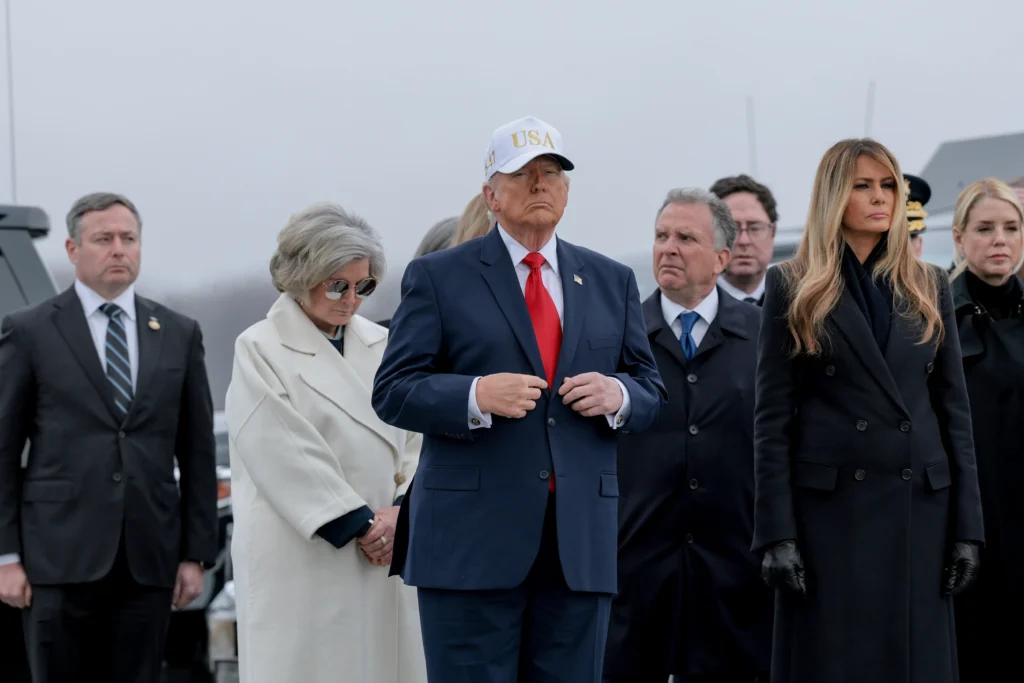
President Donald Trump is at Dover Air Force Base in Delaware on Wednesday to attend a dignified transfer for American troops killed in Jordan and Iraq over the weekend.
The transfer is a solemn process where the remains of fallen service members are transported from an aircraft to a transfer vehicle at the base.
And while the transfer is a historic process that has been done for decades, how it’s handled both in the media and by presidents has varied throughout the years.
What is a dignified transfer?
A dignified transfer is conducted for every U.S. service member who dies in a foreign conflict. It takes approximately 15 minutes and is generally a four-step process.
First, the fallen service member arrives on an aircraft, typically from Ramstein Air Base in Germany.
A “carry team” of soldiers then removes the remains from the aircraft, which are historically draped in the U.S. flag. The carry team then transfers the remains into a vehicle, which takes the remains to the Mortuary Affairs Center for positive identification and preparation.
Media coverage through the years
The process, historically, has always been the same. But what has changed is the media coverage of it all.
For nearly two decades, from 1991 to 2009, the Pentagon banned media from attending dignified transfers. At the time, the George H.W. Bush administration cited a need to protect the privacy of grieving families and prevent media distractions and disruptions during a somber process.

Unbiased. Straight Facts.TM
The dignified transfer process as it’s known today began during the Vietnam War, according to the Air Force Mortuary Affairs Division.

However, critics and some politicians argued the move was political — aimed at shielding the American public from the human tolls of the Gulf War.
The ban was extended under President George W. Bush, and it wasn’t lifted until 2009, under former President Barack Obama.
In 2009, Obama’s Pentagon changed the policy allowing for photos and coverage of the dignified transfers as long as the families of the service members permitted it.
“The core of the policy,” former Defense Secretary Robert M. Gates said, “is built around the desires of the family members, and it will be the families that decide whether or not media have access to any of these dignified transfers.”
As it stands now, families are given three options for media coverage: full media access, which allows the public to access and publish footage from the process; limited record, which allows for photos and documents for military and historical purposes, but not readily available to the public; and no recording, which disallows any video or photos during the dignified transfer.
Varying attendance from US presidents
What else has shifted through the years has been presidential attendance.
Neither George H.W. Bush nor his son attended a dignified transfer, despite it being wartime. Rather, former President George W. Bush met with military families in private to show his respect.
Obama changed that in 2009.
He attended a solemn ceremony for fallen service members and DEA agents at Dover Air Force Base that October, setting a precedent that would continue through former President Joe Biden and both of Trump’s terms.

Those presidents, however, didn’t avoid backlash like Bush faced.
Obama’s first attendance was met with some resistance, with conservative talk show host Rush Limbaugh appearing on Fox News in 2009 to criticize the move.
“It was a photo op,” Limbaugh said. ”It was a photo op precisely because he’s having big-time trouble on this whole Afghanistan dithering situation. He found one family that would allow photos to be taken. None of the others did.”
Biden also faced criticism for his attendance, after families say he checked his watch several times during the ceremony.
Trump even faced criticism earlier this year when he attended a dignified transfer for six troops killed in an Iranian strike in Kuwait. He wore a golf-style hat during the process, sparking some backlash online.
Respect, honor and dignity
At the end of the day, American Mortuary Coolers, a mortuary supply service, says a dignified transfer is about respect, honor and dignity.
Balancing that respect, respect for families and a complicated political landscape has proven difficult for recent presidents, from Trump back to George H. W. Bush.
Round out your reading
- From Obama to Trump to Biden: When networks said ‘no’ to presidential speeches.
- ‘The end of American science as we know it.’ White House funding plan sparks alarm.
- AI data centers are popping up everywhere. What exactly do they do?
- The Trump administration is accused of breaking a law built to target the KKK.
- One Republican senator is dead, another is still alive. Both are the center of conspiracy theories.