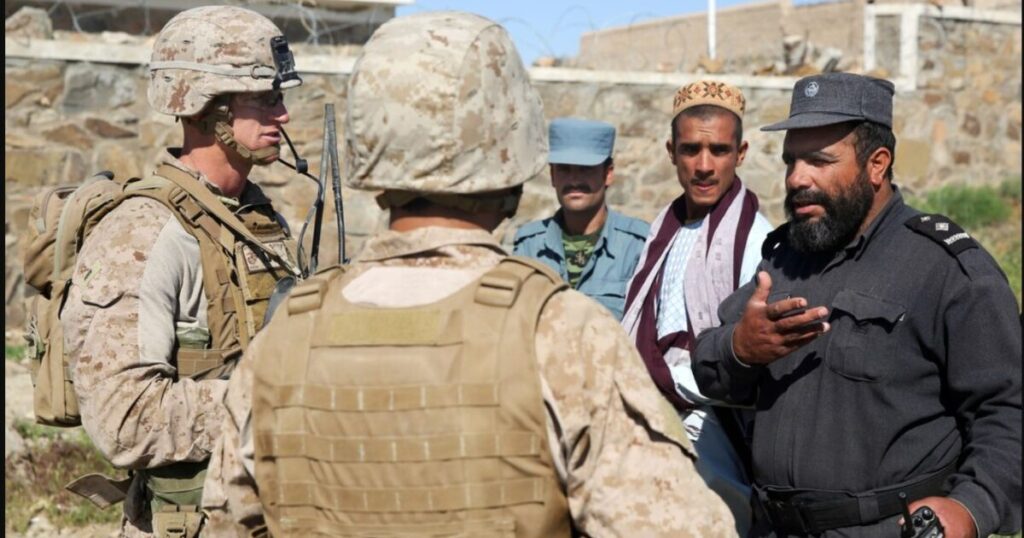


The media has consistently framed President Trump’s immigration crackdown in a negative light, not only vilifying his policies and ICE officers themselves but also misrepresenting individual cases. This gives the public the impression that immigration enforcement is inherently unlawful and that additional vetting of individuals from countries the intelligence community has identified as potential terrorism or espionage threats is unwarranted.
Coverage of Afghan nationals detained by ICE has largely framed these cases as betrayals of wartime allies, while giving little attention to why the U.S. government has applied heightened scrutiny to Afghans admitted after the 2021 U.S. troop withdrawal. For an example, see The Gateway Pundit’s July 9 article, “Media Claim: He Fought for the U.S. in Afghanistan, and ICE Killed Him. Here’s What Really Happened,” which examines the case of Mohammad Nazeer Paktiawal.
The heightened Scrutiny of Afghan nationals traces to Executive Order 14161, signed January 20, 2025, which ordered enhanced vetting review of foreign nationals. That review produced Proclamation 10949 on June 4, 2025, restricting entry from Afghanistan and 11 other countries on the stated grounds that the Taliban, a designated terrorist organization, controls the country, that Afghanistan lacks a competent authority for issuing passports or civil documents, and that DHS recorded a 9.70% overstay rate on Afghan B-1/B-2 visas and 29.30% on student and exchange visas.
After the November 26, 2025, shooting of two National Guard members by an Afghan national who had been granted asylum, USCIS tightened further, issuing a December 2 memo that paused asylum decisions and ordered re-review of already-approved benefits for nationals of the June 2025 list, Afghanistan included.
During the Biden administration’s botched withdrawal from Afghanistan, U.S. officials on the ground were relatively liberal in granting humanitarian parole to evacuate Afghans who had a plausible claim to protection. DHS paroled approximately 77,000 Afghan evacuees into the United States between July 2021 and January 2022 as part of Operation Allies Welcome.
Humanitarian parole, however, was intended only as the beginning of the immigration process, not its conclusion. Under the Immigration and Nationality Act, an alien who has not been admitted or paroled is deemed an applicant for admission, and federal regulations treat a parolee whose parole is terminated as returned to custody in the same status, subject to the expedited removal authority that governs arriving aliens. Individuals admitted on parole may ultimately be denied permanent status, and their parole may be terminated if they are later found to pose a national security or public safety risk.
That an individual fought against the Taliban proves only that, at one time, their objectives temporarily aligned with those of the United States. It does not establish that they pose no national security risk. Nor does having served alongside U.S. forces a decade or more before the withdrawal mean they are still vetted today or automatically admitted to the United States.
One of the high-profile cases currently making headlines involves Zia S., a former interpreter for U.S. forces in Afghanistan who was admitted under humanitarian parole and later challenged DHS’s decision to revoke his parole and place him in expedited removal while his green card application was pending.
He was arrested on July 16, 2025, outside a U.S. Citizenship and Immigration Services facility in East Hartford, Connecticut, following a green card biometrics appointment. Zia S. had served as an interpreter and cultural adviser for U.S. forces at Camp Mike Spann in Mazar-e-Sharif from 2005 to 2009, and he and his family entered the United States legally through JFK Airport in October 2024 under a two-year grant of humanitarian parole, using travel documents and a boarding foil issued by the U.S. Embassy in Islamabad.
Media coverage oversimplified the case. When ICE issued the Order of Expedited Removal, government attorneys wrote that his parole had been terminated because the FBI indicated he was a risk to national security and lacked “valid entry documents.” Many outlets reported this as DHS falsely claiming he had entered the country illegally, and his attorney, Lauren Cundick Petersen, said that was just not true because his parole had not been revoked as far as she knew at the time.
The dispute, however, was never over whether Zia S. had once held valid documents; both sides agreed he had. It was over the FBI flag: DHS treated the flag as grounds to revoke his parole and reclassify him as an unadmitted applicant for admission, which allowed ICE to apply Expedited Removal and bypass immigration court. His attorneys argued that using this mechanism against someone physically present in the country with a pending green card application was an unlawful application of the statute.
DHS separately alleged a “serious criminal allegation” and an ongoing investigation. The defense argued that no evidence was filed in court to support the allegation. His attorney said she had received no formal communication from DHS about any investigation and learned of the allegation only after members of the media contacted ICE. However, individuals under investigation by DHS are not necessarily notified, as doing so could alter their behavior or lead to the destruction of evidence.
Furthermore, neither the absence of publicly filed evidence nor the absence of a domestic criminal record disproves the existence of an investigation or a national security risk. National security determinations are often based on classified intelligence, counterintelligence monitoring, intercepted communications, or foreign intelligence reporting, none of which requires a prior U.S. arrest. Criminal charges, if any, typically follow an investigation rather than accompany it.
On October 3, 2025, Judge Leo Sorokin, ruling on a habeas petition in the U.S. District Court for Massachusetts, found that “nothing before the court suggests [Zia] has a criminal record” and that the government had not shown that the FBI tip justified mandatory detention. Sorokin ordered the immigration court to hold a bond hearing within seven days.
The hearing took place on October 9, and an immigration judge granted Zia a $15,000 bond after finding that the government had not shown he posed a flight risk or a danger to the community. He was released on October 14, 2025, roughly three months after his arrest. The ruling rested on the government’s failure to justify continued detention, not on any finding that the national security flag itself was baseless.
After his release, DHS said in a statement attributed to a senior official that “one lone activist judge” had released “a national of Afghanistan masquerading as an interpreter and suspected terrorist” into the community.
Release on bond does not confer citizenship, lawful permanent resident status, or immunity from deportation. Nor does it constitute the dismissal of DHS allegations or the termination of an investigation. It simply changes the individual’s custody status while the case proceeds.
Zia S.’s case continues on two tracks: the immigration proceedings and the federal district court habeas case. The central questions are whether his green card application will ultimately be approved and whether the national security determination will withstand judicial review. Both issues remain unresolved.
In April 2026, ICE detained his 19-year-old son, Rihan, on April 6. His attorney said the government attributed the detention to a computer system error regarding the expiration date of his humanitarian parole. Rihan was released on a $1,500 bond on April 21, 2026. An immigration judge later denied a motion to terminate his removal proceedings, and his case remains pending.
The underlying legal mechanism in Rihan’s case remains the same as in his father’s. Once he was flagged, DHS revoked his humanitarian parole and did not reinstate it, reclassifying him as an unadmitted applicant for admission and placing him in expedited removal proceedings similar to those his father continues to challenge.
The post Despite Media Framing, the Real Reason a Former U.S. Army Interpreter from Afghanistan May Face Deportation appeared first on The Gateway Pundit.