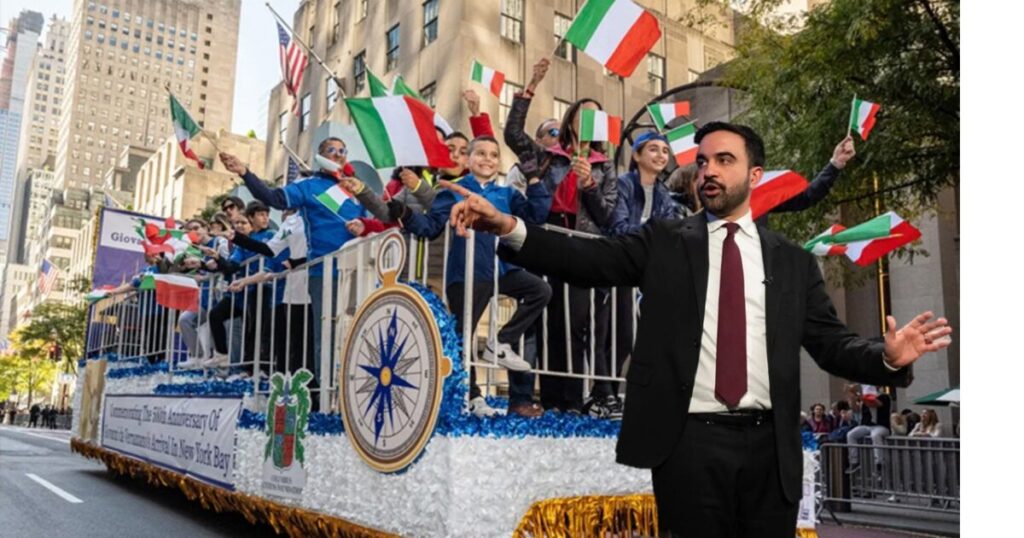


Socialist New York City Mayor Zohran Mamdani’s administration published a map highlighting the city’s immigrant neighborhoods but omitted Little Italy, as well as Greek, Irish, and Jewish enclaves. Nearly all historic immigrant neighborhoods associated with white, European-descended communities were absent.
The “New York City Immigrant Enclaves” map, tied to the 2026 FIFA World Cup, highlights 30 neighborhoods across the five boroughs, including Koreatown in Manhattan, Little Pakistan in Brooklyn, and Little Yemen in the Bronx. It appears on NYC Tourism’s Neighborhood Passport page, run “in partnership with Mayor Mamdani and Team Wonder.”
Little Italy was not the only Italian neighborhood excluded; every Italian enclave across the five boroughs was left off, including Arthur Avenue in the Bronx, Bensonhurst in Brooklyn, Howard Beach in Queens, South Staten Island, Belmont, and Dyker Heights.
The Italian American Civil Rights League (IACRL) called the omission “cultural erasure” and demanded an apology. IACRL President Mike Crispi said: “Mamdani’s City Hall can find room for every fashionable progressive constituency, but somehow it cannot find Little Italy.” The group also noted on X that the city had denied it a permit for a “Unity Day” rally the prior month.
Joseph Scelsa, founder of the Italian-American Museum on Mulberry Street, called the exclusion a “terrible mistake”: “Italian-Americans are still a major population in New York City. To not recognize where Italian-Americans came from and settled is a terrible mistake. I don’t understand why Little Italy isn’t included. I hope it’s an oversight.” City Council Member Vickie Paladino, a Republican representing northeast Queens, mocked the map on X by renaming her district “Little America.”
Census data show the scale of what was left out. More than 4 million Italians immigrated to the U.S. between the 1880s and 1924, roughly a third of whom settled in New York City. Today, New York City has the largest Italian population of any U.S. city, at 492,127, while Italian Americans statewide number 2.2 million, or 11.1% of New York state’s population.
Another significant European community that was excluded was the Greek community in Astoria, Queens. The map instead labels part of the neighborhood “Little Egypt.” By the end of the 1960s, the neighborhood held the world’s largest population of Greeks outside Greece itself, and census data show Greek remains the most commonly spoken non-English, non-Spanish language spoken there. Today, the greater New York region’s Greek diaspora is the second-largest in the world outside Greece, trailing only Melbourne.
Every immigrant group shaped New York’s development, but Italian and Jewish communities produced a documented share of the city’s cultural output, extending from film and language into food.
Yiddish, brought by Ashkenazi Jewish immigrants who arrived between 1881 and 1924 and settled densely on the Lower East Side, shaped New York speech beyond individual loanwords. “Schlep,” “chutzpah,” “schmooze,” “kvetch,” “bubkes,” and “klutz” entered everyday English, alongside rhetorical patterns like “I should be so lucky” and “Enough already.”
Jewish immigrants also shaped New York’s food identity: the boiled-then-baked bagel, lox and cream cheese as a kosher-compliant alternative to meat and dairy combinations, pastrami and corned beef on rye from Romanian Jewish delis, the knish, matzo ball soup, and the cream-cheese-based New York cheesecake style popularized in the 1920s and 30s.
Jewish writers and performers shaped American television and film from the medium’s early days. The writers’ room of Your Show of Shows in the 1950s, which included Mel Brooks, Carl Reiner, and Neil Simon, helped establish the modern sitcom format.
NBC president Brandon Tartikoff nearly rejected Seinfeld’s 1989 pilot, calling it “too New York, too Jewish”; the show went on to become one of the most successful sitcoms in history. Curb Your Enthusiasm, The Nanny, The Marvelous Mrs. Maisel, and Saturday Night Live extend the same lineage, alongside film archetypes shaped by Jewish directors and writers, including Mel Brooks’ satirical treatment of Hitler in The Producers.
Woody Allen turned the secular, mid-century Jewish New York experience into a film genre. Annie Hall (1977) and Manhattan (1979) established the archetype of the anxious, intellectual New York Jew in global pop culture, built on Yiddish figures like the schlemiel and the nebbish and often played against WASP culture for contrast. Through Allen, a defining “New Yorker” in the global imagination became a fast-talking intellectual analyzing his way through an existential crisis in Central Park.
Italians similarly added to pop culture. The American Film Institute’s list of the 100 greatest American films ranks The Godfather third and includes Goodfellas. Similarly, although it is not strictly a New York show and spills over into Northern Jersey, The Sopranos is one of the most popular drama series ever made.
Slang words derived from Italian, particularly Sicilian and other southern Italian dialects, have become part of the standard New York vernacular and have spread across the country through television and movies.
Sicilian and southern Italian pronunciations transformed “capicola” into “gabagool,” “mozzarella” into “mutzadell,” “prosciutto” into “proshoot,” and “manicotti” into “manigot”—terms The Sopranos popularized nationally, although the pronunciations predate the show.
Speakers with no Italian ancestry use these words alongside others that extend beyond food: “goomba” for a loyal neighborhood associate, “stunad” and “mamaluke” for foolish behavior, “agita” for stress caused by another person, “madone” as an exclamation of shock, “capeesh” to end an explanation, and “gravy,” rather than “sauce,” for the slow-cooked Sunday tomato sauce simmered with meat.
On top of all their other contributions, New York’s two most iconic foods are bagels and pizza, Jewish and Italian, respectively.
By excluding Jewish and Italian neighborhoods from his map, Mamdani erased much of the city’s culture, history, language, movies, television, and food while excluding about a quarter of its population.
The post Mamdani Omits Italian and Jewish Neighborhoods From NYC Immigrant Map appeared first on The Gateway Pundit.