This post was originally published on this site.
The new space race is on. Except instead of countries racing to the moon, it’s some of the biggest companies, and richest men, on Earth running to use satellites to provide broadband internet to the world.
Amazon’s Leo satellite network is nearing operation and is expected to be functional before the end of the year. Once it does, it will compete with Elon Musk’s Starlink and several others.
“It’s a wonderful passion play of different egos involving some of the wealthiest people in the world, so it’s really very fascinating,” Rob Frieden, academy and emeritus professor of telecommunications and law at Penn State University, told Straight Arrow.
Amazon Leo
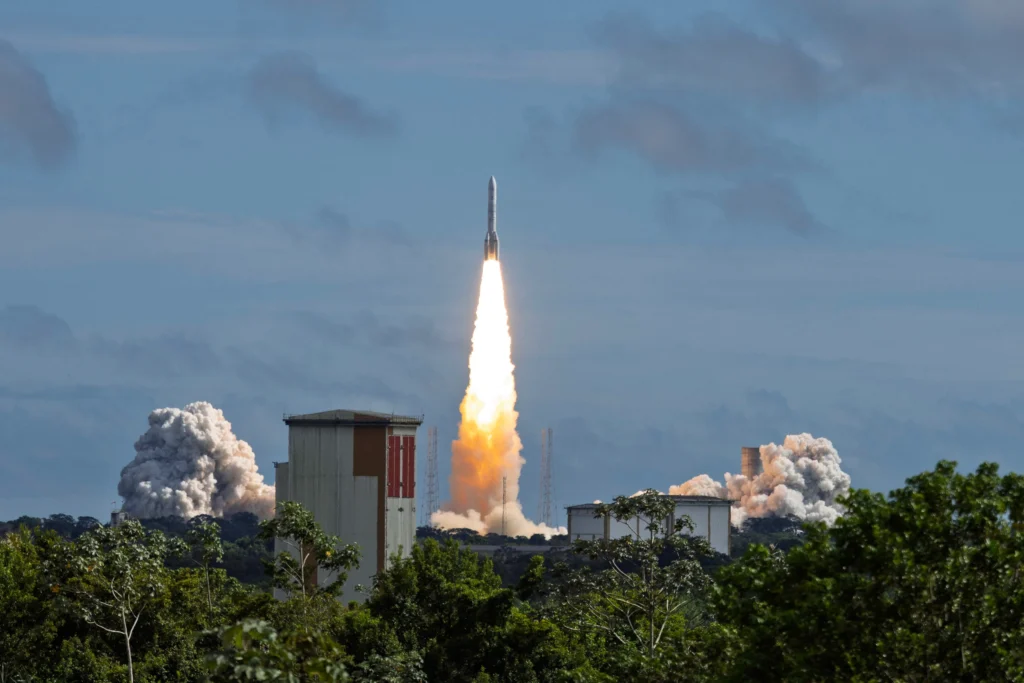
Amazon has launched roughly 400 satellites as part of this program.
Once it’s up and running, it will provide high-speed internet access to people, businesses and governments in underserved areas.
The low-Earth orbit (LEO) machines operate anywhere from 350-500 miles off the Earth’s surface.
“The way these low-Earth orbit satellites work is you have a whole bunch of these satellites that are moving through the sky in a way that one of them or more of them should be in view often enough of a receiver that you can do broadband at the same quality or close to the same quality you can do with wireless towers on the ground,” Harold Feld, senior vice president at Public Knowledge, told Straight Arrow.
The last launch for this program came earlier this month.
Amazon sent up 29 satellites to join its growing constellation.
“They will be very important, particularly in regions that don’t have service or have very poor service right now,” Jon Peha, professor and center director at Carnegie Mellon University, told Straight Arrow.
As part of their plan to service millions around the world, Amazon has also purchased rival Globalstar, which already has dozens of satellites in the sky with more to come.
Feld said some of the satellites are low-Earth orbiting while some are considered “MEO,” or middle-Earth orbit space devices.
Eventually, Amazon plans to have more than 3,000 satellites in its network.
Amazon has also announced a partnership with Apple.
That agreement will allow Amazon Leo to power satellite services for many iPhone and Apple Watch models.
Users in remote areas who have no reception can connect to a satellite to text emergency services, message family and friends and more.
“It is not a solution to all problems,” Peha said. “We still want very good terrestrial systems to serve our cities, but it fills an important gap.”
The competition
Amazon may be the biggest player when it comes to domestic deliveries on Earth’s surface, but it’s got some serious catching up to do when it comes to space.

Particularly with Musk’s Starlink, which is part of SpaceX, and already has more than 10,000 satellites working in orbit and is already being used by tens of millions of people.
“Musk is an early mover, has vertical integration, manufactures launch vehicles,” Frieden said. “Getting launch services is a problem for Amazon.”
The FCC set a deadline of July 30 for Amazon to get half of its planned 3,000+ satellites in the sky.
Amazon filed paperwork in January asking to waive or extend that deadline because of launch issues, manufacturing challenges and more.
The FCC obliged, but Amazon is still required to get all its satellites up by July 30, 2028.
“They have the problem of not being vertically integrated with manufacturing of satellites and manufacturing of vehicles,” Frieden said. “So, they have to go into the market and get secure launches.”
One complaint that’s come up at times with Starlink is the price, including a major price hike earlier this year.
With another major player like Amazon entering the market, costs could come down.
“Competition is good,” Feld said. “Competition lowers prices. Amazon understands about undercutting their rivals.”
Where Amazon does have a small advantage is its cloud capabilities and infrastructure on the ground.
Amazon Web Services (AWS) has the largest market share in the cloud space.
“They’re definitely going to be able to integrate terrestrial functionality with orbital functionality to support the intercorporate broadband requirements,” Frieden said.
As of now, Amazon is not even number two.
A company called Eutelsat OneWeb has more than 650 satellites in the sky.
The involvement of that company brings another billionaire into the space race.

OneWeb was founded by Richard Branson and others before merging with Eutelsat.
“People see money,” Peha said. “Whether they will all succeed, I don’t know. But some will.”
Government involvement
The FCC regulates these projects, but that’s not where government involvement ends.
The feds have mostly avoided subsidizing Starlink or Amazon Leo, but that could change thanks to a new federal program called Broadband Equity, Access, and Deployment (BEAD).
That’s a more than $40 billion federal grant program that will provide funding for states to expand internet access in underserved communities.
Starlink, Amazon or any other player can receive some of those funds if they are selected by the states.
It began under the Biden administration with a focus on terrestrial wireless connections and fiber deployment.
However, when Trump retook power, his team changed the rules on BEAD to make things more suitable for his one-time friend Musk.

“Basically, they lowered the amount of money you could get for each place where you were deploying,” Feld said. “So, satellite became the default for a lot of these areas.”
Arkansas has already agreed to deals with both companies.
Where the federal government is more likely to subsidize is for the actual launches themselves.
“The Department of Commerce and a number of federal agencies that do broadband grants provide a lot of money to at least get satellites off the ground,” Feld said.
While the feds may not be directly subsidizing these projects, that hasn’t stopped them from being a customer.
The Department of Defense has a contract with Starlink for military operations, government communications and more.
“SpaceX, since it has global coverage, the military uses them,” Feld said.
However, that relationship has soured a bit during the Iran war after Musk accused the Trump administration of violating the contract.
Artificial Intelligence
Much like every other aspect of tech these days, artificial intelligence also comes into play here.
There’s been significant pushback on the data centers required to support AI due to several factors, including water usage, noise and more.
But what if those data centers weren’t on Earth and instead in orbit?
“The possibility of using these low-Earth orbiting satellites as data centers in space, orbiting data centers, is an attractive alternative,” Frieden said. “It’s not polluting. It doesn’t use water. It’s got unlimited solar power.”
Musk is already planning for this.
While there are plenty of benefits, there are also some issues with that plan.
Space data centers will likely be very expensive, difficult to repair and suffer possible communication delays no matter how close to the surface they are.
However, this is likely going to be another factor in this ongoing race between Amazon and SpaceX.
“The future of AI is somewhat at stake, given how these two operators and these two companies are,” Frieden said.
Round out your reading
- From Obama to Trump to Biden: When networks said ‘no’ to presidential speeches.
- ‘The end of American science as we know it.’ White House funding plan sparks alarm.
- AI data centers are popping up everywhere. What exactly do they do?
- The Trump administration is accused of breaking a law built to target the KKK.
- One Republican senator is dead, another is still alive. Both are the center of conspiracy theories.