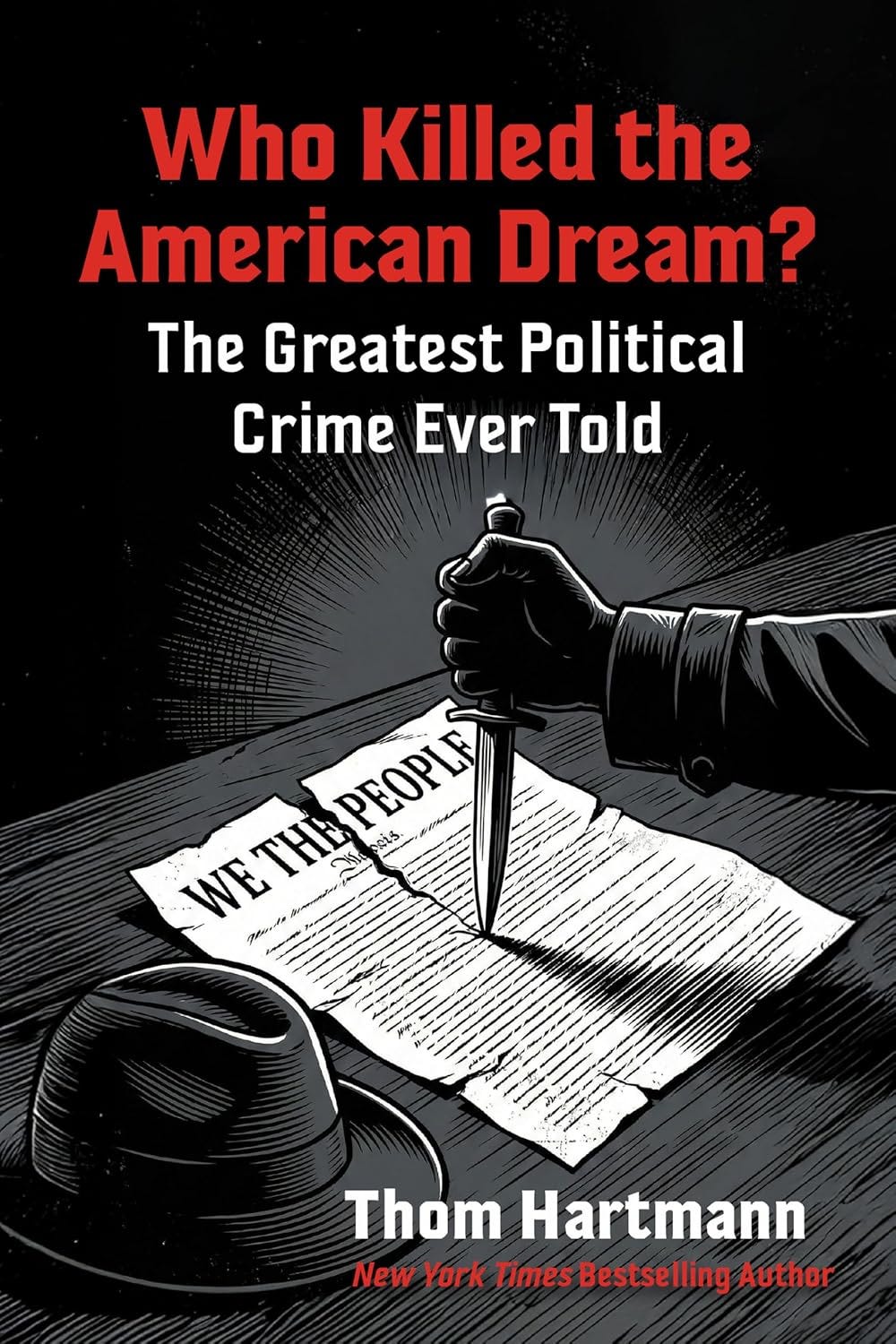
Yesterday I published Chapter 9 from my new book Who Killed the American Dream? detailing how nearly a half-century of Reaganomics have left the middle class in this country in tatters.
— Houses in 1981 — when Reagan was sworn into office and kicked off the neoliberal Reagan Revolution — cost about 3 times an individual worker’s annual paycheck; today it’s roughly 10 times.
— It was that decade when productivity stopped tracking payroll for the first time in almost a century; if workers today were paid based on the same productivity formula as they were that year and for most of a century before, the average salary would be $100,000 a year, about twice what it is today. If the federal minimum wage had simply tracked inflation since 1964 it would be around $14 nationally now, also about twice what it is today.
— Drugs were cheap, hospitals and health insurance companies were non-profits, college was free or cheap, and because anti-monopoly laws were enforced until Reagan stopped the antitrust cops in 1983 both suburban malls and downtown main streets were filled with local family-owned businesses.
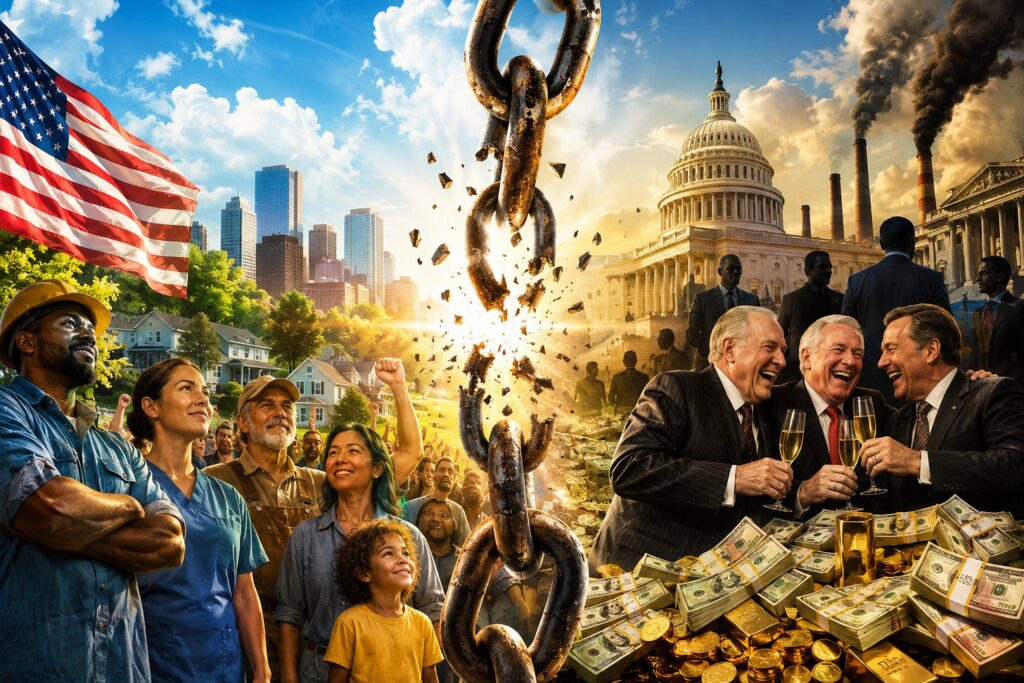
All of these changes — literally every single one — has come about because Republicans working in service to America’s morbidly rich oligarchs were successful in using treason to seize political power in 1980, and then used that power to gut the Democratic Party’s single largest source of funding.
And the biggest factor in facilitating all of these decades of GOP rule since was that single variable: the 1980s destruction of America’s labor unions.
Mention unions today and the media will yawn, but they were the key component to building the world’s first middle class that reached more than half a nation’s population by the 1960s.
In 1981, two-thirds of us were in that middle class with a single paycheck; today it’s between 41 and 47 percent of us (depending on whose numbers you use) and it requires two full-time paychecks. The single largest reason for this change is Reagan’s intentional destruction of America’s labor unions.
Unions funded Harry Truman’s run for the White House, as they did JFK’s, LBJs, and Jimmy Carter’s. In the pre-Reagan Revolution era, there was roughly equal financial firepower between the two political parties; Republican campaigns were funded by big corporations and oligarchs, while unions paid most of the bills for Democrats.
The billionaires who funded the Heritage Foundation and other rightwing think tanks in the 1980s knew that the key to Democrats getting elected was union money. FDR had legalized unions with the Wagner Act in 1935 and even though Republicans had pushed through the despicable Taft-Hartley anti-union “right to work for less” act over Truman’s veto in 1947, unions were still growing and wealthy.
So, when Heritage issued its Project 2025-like “Mandate for Leadership” action plan for the Reagan administration in 1981, it carried an extensive section on how Reagan and Republicans across the nation could cripple the union movement.
Most people figured this was just because the big companies that helped fund these think tanks wanted cheaper labor, and that was certainly part of it. But the biggest and most audacious reason Reagan took their advice was purely political: to eliminate the largest source of campaign cash Democrats could tap into.
And it worked.
When Reagan came into office about a third of us had good union jobs, which meant about two-thirds of us had the middle class equivalents of union pay and benefits because the unions set the local wage and benefit floors that employers had to match to compete for workers.
But by 1992, Reagan’s and GHW Bush’s efforts — along with Red state governors and legislators who’d adopted the Taft-Hartey “right to work for less” provisions — had reduced private sector union density to a mere 11 percent of us.
With the unions hanging on by their fingernails, Democratic presidential candidate Bill Clinton faced a real dilemma that year: where could he find enough big money to fund a presidential campaign?
The internet was then pretty much nothing more than AOL and CompuServe and nobody was using it for fundraising with any success. And most of the morbidly rich supported the GOP’s efforts to cut taxes on billionaires and gut regulations that protected average people so they weren’t inclined to help out Democratic candidates.
What Clinton came up with was a “Third Way” that meant getting into bed with “clean industries” like banking, insurance, and pharma rather than the “dirty industries” like oil, mining, and chemicals that Republicans had embraced for decades. The new mantra for Clinton’s signing NAFTA, keeping income tax rates below 50%, and other Reaganista neoliberal policies was, he argued, that white- and pink-collar jobs should replace blue-collar factory work and this transformation of the workplace would be a good thing overall for Americans.
To make it work, Clinton had to abandon many of the traditional positions of the Democratic Party, dating back to FDR’s 1930s New Deal.
There would be no re-embrace of unions in his or Obama’s equally neoliberal administrations by passing Card Check or other progressive policies that made it easier to join and stay in a union. The “era of big government” was declared dead, as was “welfare, as we know it.”
As a result, the biggest difference today between so-called “centrist” or “moderate” Democrats and their progressive challengers is grounded in this dynamic.
Progressives know that without a strong union movement no middle class encompassing more than half a nation’s population is possible. And they know that unions have historically served as the organizing nexus for both protest and reform movements across modern history. Unions today, for example, often lead protest movements across Europe.
“Moderate Democrats” on the other hand, are happy to take money from big corporations (and AIPAC) that fight unions every step of the way; as a result, they’ve either resisted or only offered lip service for passage of the Pro Act and other pro-union efforts to rebuild America’s middle class.
Unions have always been the singular engine that creates and sustains a middle class in every country where that’s happened, throughout history.
In the 14th century when a third of Europeans died in the Black Plague, the resulting labor shortage caused workers to band together into guilds, the first modern labor unions. Those guilds set the price of labor high enough that Europe’s first middle class emerged, giving working class people the free time to explore music, philosophy, literature, and science. The result is what we call the Renaissance.
The same thing happened in the 1960s here in America with a musical and cultural renaissance, when Russell Kirk and his colleagues believed that the country was suddenly falling apart with students burning draft cards, women demanding equality in the workplace, and Black people pushing back against endemic police violence with both the Civil Rights movement and lighting cities on fire when cops beat or killed unarmed people. (Contrary to what Limbaugh told you, every single “riot” in that era was the result of, and in reaction to, a specific act of unprovoked police violence.)
A revitalized union movement will not only raise the standard of living for working Americans; it’ll also provide the exus for organizing against fascism, another reason why Heritage doubled down against them with Project 2025, which recommended stripping union rights from government workers, something Trump has now done.
Unions could also protect us from AI-related job losses and work America toward a universal basic income if that’s what will be necessary as the world changes with the AI revolution.
Americans living in states that have had strong union movements within living memory understand this dynamic well; it’s why Abdul El-Sayed got the endorsement of the United Auto Workers, Michigan’s largest union, and is doing so well in this Tuesday’s primary against Haley Stevens, who’s proud to take money from union-busting corporations and calls voters concerned about her campaign finance issues “zombies.”
Given that Trump and/or Vance will probably wield a veto pen for the next two-and-a-half years it’s premature to demand that Congress pass the Pro Act or a newer version that overturns Taft-Hartley and re-enshrines union rights today, but two years is also a perfect amount of time to begin building a strong consensus and pro-union movement within the Democratic Party.
The most powerful force to fight oligarchy and the GOP’s neofascism long term — and to bring back America’s middle class — is to rebuild America’s unions.
Let your elected Democrats know, and show up at your local Democratic Party meeting to offer your input.
Louise’s Daily Song: “The Greatest Heist”
Comments on the Saturday Report:
Saturday Report 8/1/26 — Geeky Science: Blue Zone Centenarians Share This Overlooked Trait…
I am a Teddy Roosevelt Republican…. Otherwise known as a Democratic Socialist.
The key for me, as a white, upper-middle-class educated professional, is No Corporate or PAC money. Otherwise, the politician is not working for the people; they are working for the corporations.
It’s actually quite simple… I am a Peopleatist…
~ Spencer Witing
Thom, a week of well a lot of stupid . These, people don’t check any facts out, Thom! When, you lie all the time, why would you think facts not lies are what the American people really want.
~ Jackie
Get the day’s news, both as a video and written report by Thom Hartmann, as well as a downloadable or an audio podcast, delivered right to your inbox every morning for free at CommonwealthReport.news:

My newest book, Who Killed the American Dream?: The Greatest Political Crime Ever Told is now available for presale from bookstores nationwide. It’s a modern-day telling of the “murder mystery” of how a great crime was committed against America by a cynical court reporter and an on-the-take Supreme Court justice that changed the course of American politics and led straight to Citizens United. It also details the massive ongoing cover-up of this crime and what we can do to fight back.